
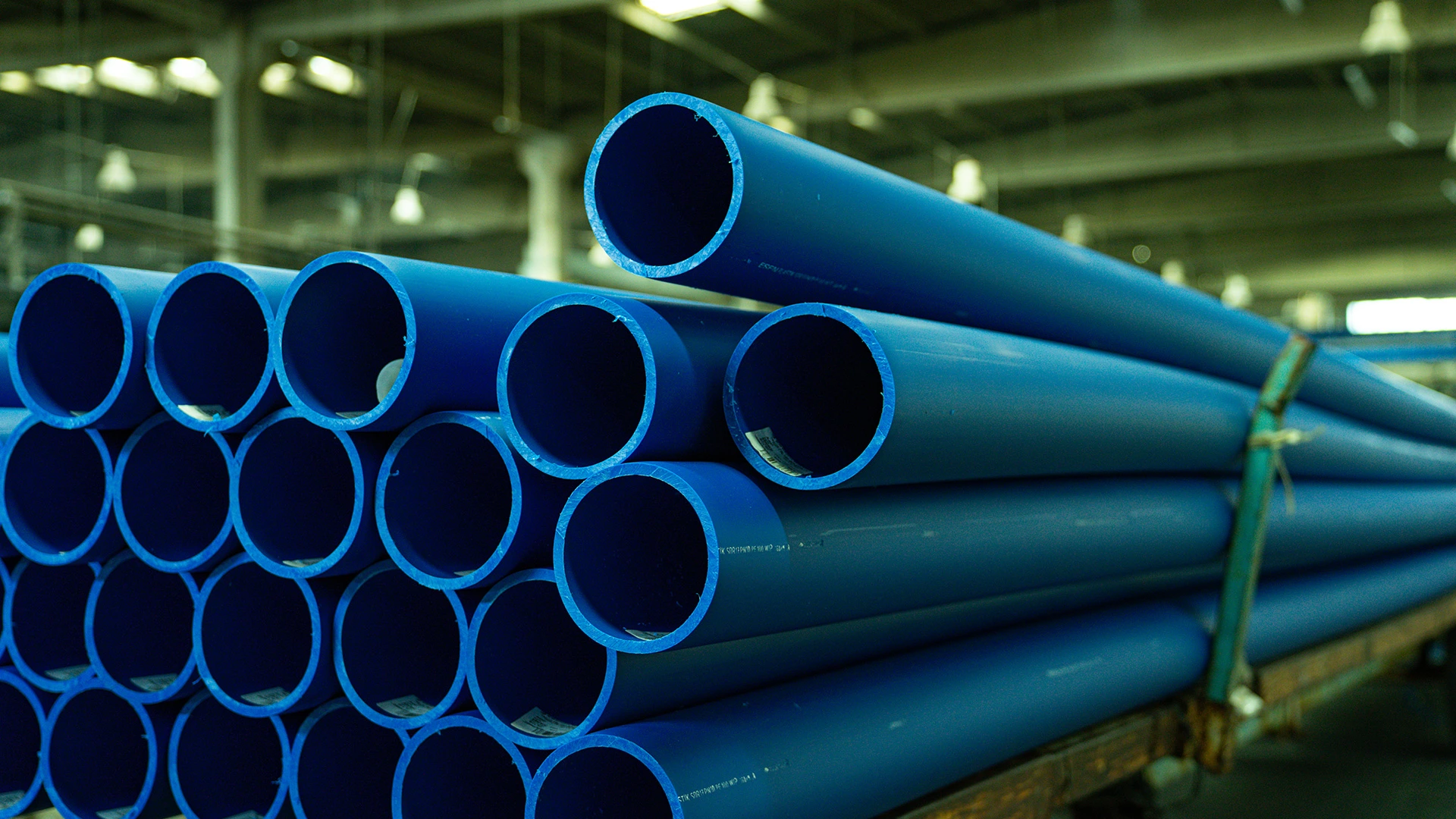
Polyethylene pipes are among the most widely used types of pipes in water supply, gas distribution, sewage systems, agriculture, and fluid transmission systems. Their popularity is due to their high strength, suitable flexibility, long service life, and low maintenance costs.
To produce high-quality, standard-compliant pipes, the manufacturing process must be precise, well-controlled, and carried out in accordance with recognized standards. In this article, we examine the polyethylene pipe production process from start to finish and explain key points related to raw materials and quality control.
1. Understanding the Raw Materials of Polyethylene Pipes
The main raw material used in the production of polyethylene pipes is high-density polyethylene (HDPE) granules. Depending on the application of the pipe, these granules are commonly used in three grades:
-
PE80 for medium-pressure applications
-
PE100 for high-pressure applications and water and gas distribution systems
-
PE100-RC, suitable for harsh conditions and offering higher resistance to crack propagation
The granules must be supplied by reputable manufacturers such as Jam Petrochemical, Amirkabir Petrochemical, Tabriz Petrochemical, Borouge, or SABIC.
The quality of the granules has a direct impact on the pipe’s strength, flexibility, and service life. The use of recycled granules reduces strength and increases the risk of leakage and cracking; therefore, reputable factories never use recycled materials in the production of pressure pipes.
2. First Stage: Drying and Preparation of Raw Materials
Before entering the production line, polyethylene granules must be free of moisture, as the presence of moisture causes bubbles and internal cracks in the pipe.
At this stage, the granules are fed into a dryer hopper and dried at a controlled temperature. The materials are then transferred to the extruder via automatic feeders.
3. Second Stage: Melting the Material in the Extruder
The extruder is the core component of the polyethylene pipe production line.
In this section, the granules are conveyed through the extruder barrel by a rotating screw, where they are melted under controlled temperature and pressure. Key factors in this stage include:
-
Precise adjustment of heater temperatures
-
Proper screw rotation speed
-
Melt homogenization
If the temperature or screw speed is not correctly set, the pipe wall thickness becomes non-uniform and the final product quality is compromised.
4. Third Stage: Initial Forming in the Die Head
After complete melting, the polyethylene melt exits through the die head. Dies are designed based on the pipe diameter and play a critical role in determining the quality of the pipe’s inner and outer surfaces.
At this stage, the pipe wall thickness, outer diameter, and initial shape uniformity are defined. Any error in die design can result in poor-quality pipes with uneven wall thickness.
5. Fourth Stage: Cooling in the Vacuum Tank
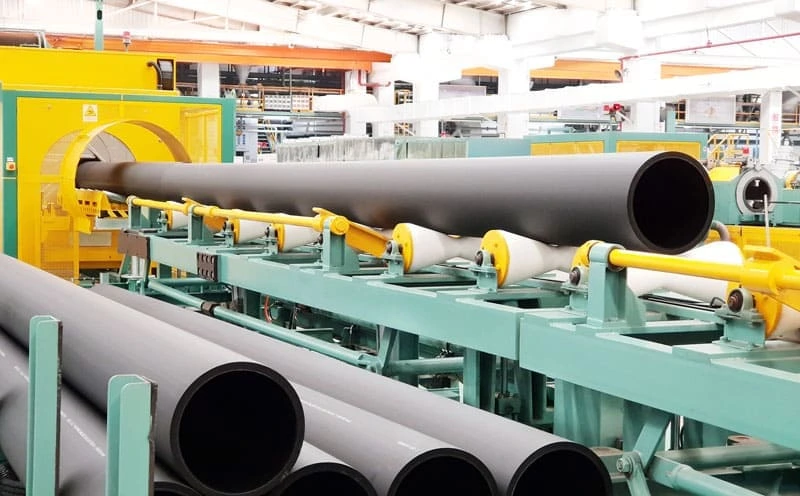
After exiting the die head, the pipe enters the vacuum tank to achieve the most accurate possible diameter. In this tank:
-
The pipe is subjected to vacuum pressure
-
It is cooled with cold water
-
Its structure is stabilized
The presence of a vacuum tank is one of the key differences between professional production lines and low-quality ones, as it has a direct impact on the accuracy of the outer diameter.
6. Fifth Stage: Final Cooling and Pipe Haul-Off
After initial forming, the pipe passes through cooling tanks to be completely cooled. It is then pulled forward at a uniform speed by the haul-off unit.
Adjusting the haul-off speed is extremely critical:
-
Excessive speed reduces wall thickness
-
Low speed increases wall thickness
At this stage, the pipe’s surface quality, smoothness, and wall uniformity are determined.
7. Sixth Stage: Cutting and Packaging into Standard Lengths and Coils
After leaving the production line:
-
Small-diameter pipes (up to 110 mm) are usually packaged in coils
-
Large-diameter pipes (above 125 mm) are cut into 6-meter or 12-meter lengths
Accurate cutting and proper packaging facilitate transportation and installation.
8. Recognized Standards in Polyethylene Pipe Manufacturing
Polyethylene pipe production must comply with recognized standards. The most important ones include:
-
Iran National Standard ISIRI 14427
-
ISO 4427 (water supply)
-
ISO 4437 (gas distribution)
-
DIN 8074 and DIN 8075
-
EN 12201
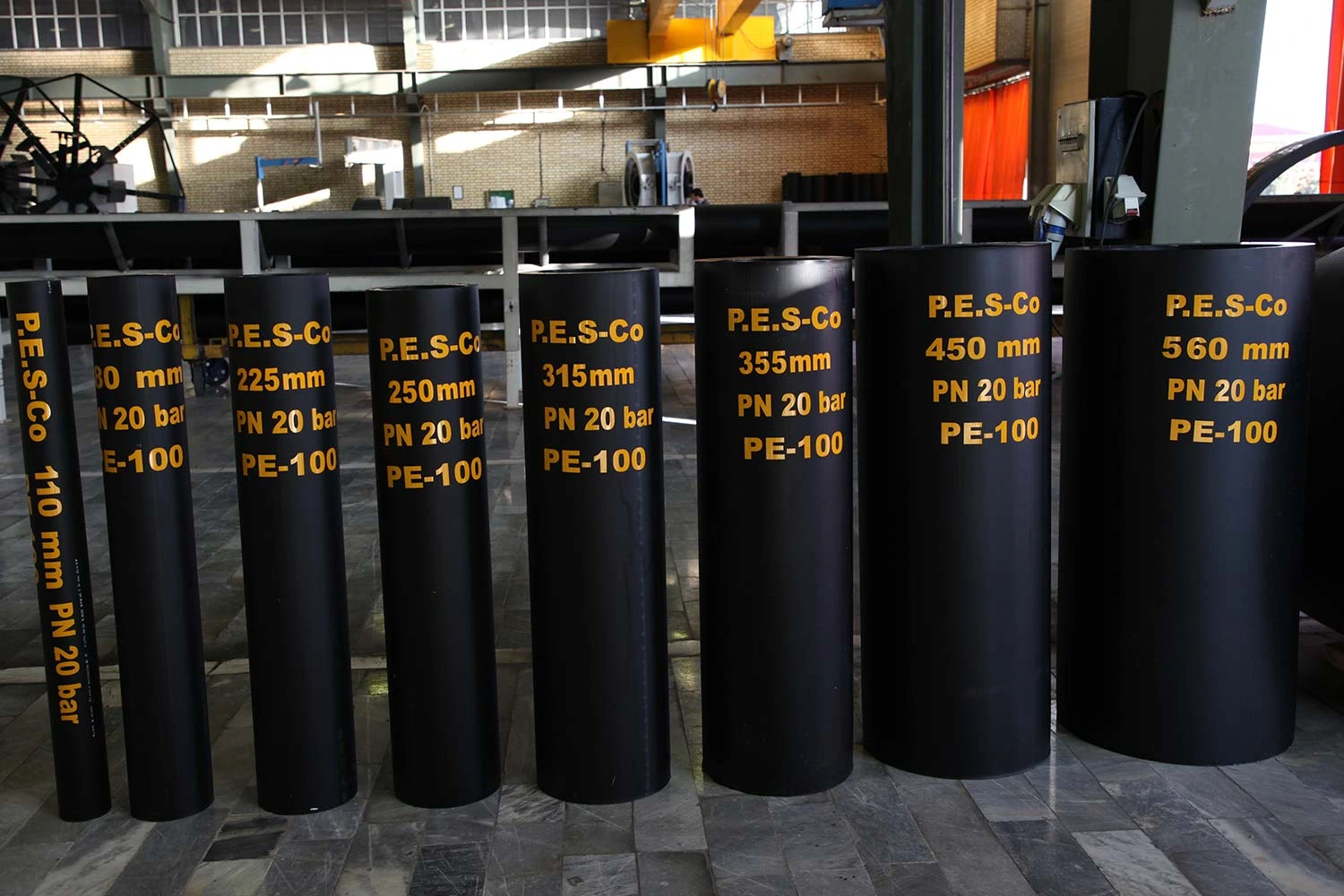
Compliance with these standards ensures that the pipes fully meet global criteria in terms of wall thickness, pressure resistance, weight, and raw material quality.
9. Quality Control (QC) System in Polyethylene Pipe Manufacturing Plants
The Quality Control (QC) unit is one of the most critical departments in a manufacturing plant. In this unit, pipes are evaluated at different stages of production using the following tests:
Common tests include:
-
Hydrostatic pressure test to assess pressure resistance
-
MFI test (Melt Flow Index) to evaluate the melt flow characteristics of the material
-
Impact resistance test
-
Wall thickness measurement using laser devices
-
Resistance to cracking tests (ESCR / SCG)
-
Ovality (concentricity) inspection
The availability of official laboratory test reports and the ability to provide them to customers are clear indicators of a reputable manufacturer.
10. Factors Affecting the Final Quality of Polyethylene Pipes
To achieve a high-quality final product, several factors must be controlled simultaneously:
-
Quality of polyethylene granules
-
Precision and performance of the extruder
-
Up-to-date and properly designed dies
-
Accurate calibration of the vacuum tank
-
Proper adjustment of production speed
-
Precise temperature control throughout all stages
-
Presence of an active QC unit
Factories that successfully manage this cycle can produce pipes with a service life exceeding 50 years.
Conclusion
Polyethylene pipe manufacturing is a precise and specialized process that requires full control from raw material preparation to final packaging. Compliance with international standards, the use of high-quality granules, and the implementation of quality control tests ensure reliable performance, long service life, and adequate resistance of the pipes.
If you plan to purchase or use polyethylene pipes in large-scale or critical projects, understanding the manufacturing process will help you choose the best supplier and the most suitable product with confidence.